
Your audience is not ignoring your brand because your product is weak. They are ignoring it because their brain has not decided you are safe yet. That is not a marketing problem. That is a neuroscience problem. And a brand message house is the most practical tool to solve it. This guide walks you through exactly what a brand message house is, why consistent messaging is neurologically necessary, and how to build one that your whole team can use, across every touchpoint, every time.
Table of contents
TL;DR
- The mere exposure effect proves your audience needs to hear the same message repeatedly before they trust it
- A brand message house is the framework that makes consistent repetition possible without sounding robotic
- It has four layers: roof (core promise), pillars (supporting messages), walls (tone and personality), and foundation (proof points)
- Most message houses fail because they are built as one-off exercises and never activated
- Building one takes six steps, starting with your audience, not your product
- Review it quarterly, but protect the core
Why does your brain trust what it recognises?
Before we build anything, you need to understand why consistent brand messaging is not a nice-to-have. It is how the human brain makes decisions.
The Mere Exposure Effect (MEE) is a psychological phenomenon where individuals develop a preference for people, products, or stimuli simply because they are familiar with them. Repeated, unreinforced exposure to a stimulus increases liking, because familiarity reduces uncertainty and makes things feel safe. The mere exposure effect is widely applied in brand recognition strategies, advertising, interpersonal relationship building, and even in political campaigns. It is an unconscious process, which means the effect occurs even if the person does not consciously remember previous exposures.
Psychologist Robert Zajonc coined the term “mere exposure effect” after he first demonstrated it in a 1968 study, exposing participants to unfamiliar stimuli (such as photographs of faces, Turkish-like nonsense words, Chinese pictograms) and measuring their preference ratings. The result was clear: the frequency of exposure to a face, a sign, an object, a sound, or an image was directly correlated with how positively participants rated it, because it felt familiar.
In marketing, this translates directly to purchase behaviour. Repeated exposure to consistent brand messages increases consumer trust and purchase likelihood because familiarity removes the cognitive effort of evaluation. Once your audience has learned that your brand is a safe choice, their brains actively prefer to skip a deep analysis of alternatives. They stick with what they know over what is new and unknown.
The unknown is always scary, because the brain is wired to keep us alive rather than happy. It perceives uncertainty as a potential threat, often triggering a “fight or flight” response, anxiety, and stress to protect us. We are neurologically programmed to treat unfamiliar stimuli as potential threats and to avoid unnecessary risk. New brands, inconsistent messaging, or a different tone every time you show up all of these trigger mild uncertainty responses. Familiar, consistent brands bypass that response entirely.
This is why the world’s strongest brands say the same things, in the same way, across every touchpoint, for years. Not because their marketers lack creativity. Because their strategists understand neuroscience. And this is exactly why you need a brand message house. It helps your team to stay consistent in their brand and marketing communication.
What is a brand message house?
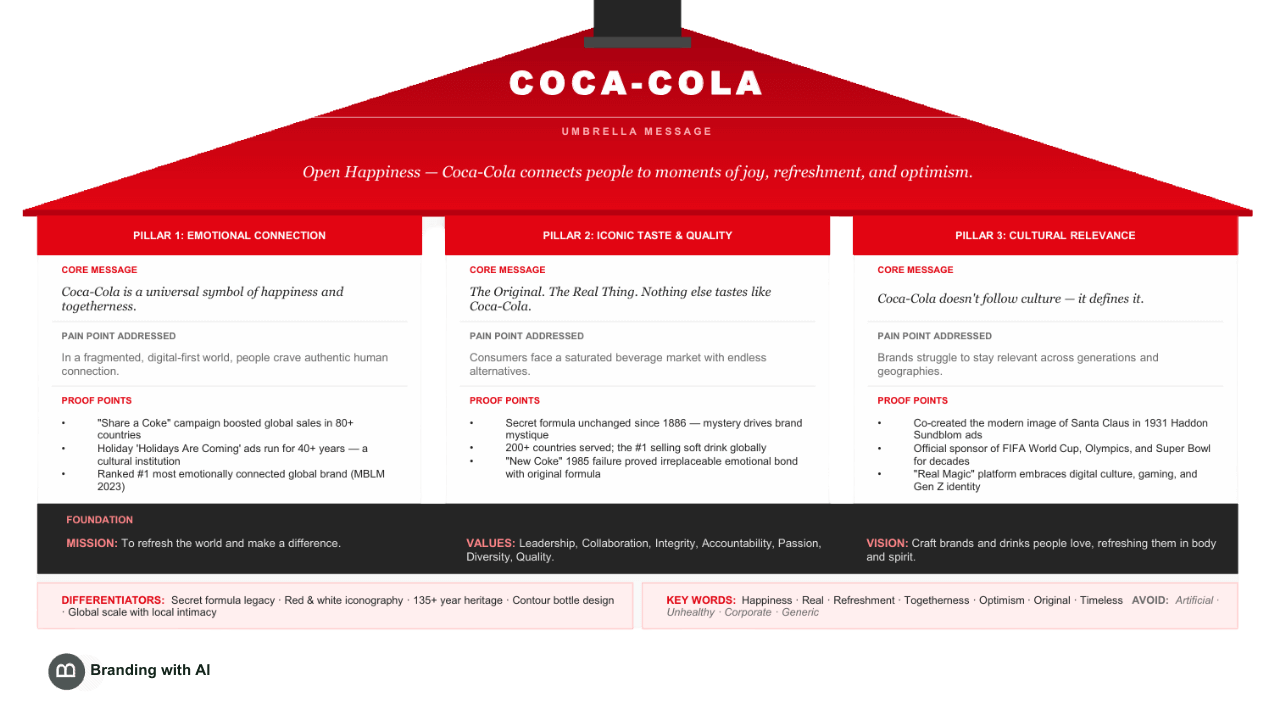
A brand message house is a strategic communication framework that organises your brand’s core narrative into a structured hierarchy of messages. Think of it literally as a house: every part has a role, and if one part is missing, the whole structure is unstable.
The metaphor matters because it captures something flat frameworks miss: your messages are not equal. Some are foundational and should never change. Others flex depending on channel, audience, or campaign. A message house maps those relationships clearly so that everyone communicating on behalf of your brand, whether that is you, a team member, an agency, or an AI tool, is working from the same coherent architecture. It also represents that some core messages have to be told repeatedly, even more frequently than others.
Where a brand message house becomes essential is brand activation. It is the document that makes the Mere Exposure Effect achievable in practice. Without it, every piece of content is improvised. With it, repetition becomes systematic, and systematic repetition is what builds the familiarity your audience’s brain craves before it decides to trust you.
What is the origin of the brand message house?
The “Message House” (or “Messaging House”) framework doesn’t have a single clear originator. It evolved organically within communications, PR, and marketing strategy circles over decades. PR and political communications shaped it heavily in the 1990s-2000s, particularly in crisis comms and political messaging. McKinsey and major consultancies popularized structured message architecture in corporate strategy contexts, which influenced how brand strategists adopted the house metaphor. Some attribute early versions to Barbara Minto’s Pyramid Principle (1987), which structured communication hierarchically; the house is essentially a visual reframe of that logic. For brand building specifically, it became mainstream vocabulary through brand consultancies in the early 2000s, but no one “owns” it the way Simon Sinek owns the Golden Circle or Marty Neumeier owns Brand Gap concepts.
Before you build one
Before you build one, it is worth understanding why most of them fail. Because they do, regularly.
The first failure is treating the message house as a deliverable rather than a tool. It gets created during a rebrand, celebrated in a meeting, then quietly filed in a folder nobody revisits. Six months later, the sales deck says one thing, the website says another, and the LinkedIn posts belong to a different brand entirely. The Mere Exposure Effect cannot work if your audience encounters a different version of your brand every time they look.
The second failure is more human, and if you have worked in a team of more than three people, you will recognise it immediately. Propose a new infrastructure migration, and the room goes quiet. Everyone respects that it requires specialist knowledge. Propose a new brand message, and suddenly the whole room has opinions. Unlike technical disciplines that most people wisely leave to the experts, messaging feels accessible because everyone has written an email and everyone has a favourite word. The result is a message house quietly shaped by whoever argued most confidently, rather than by what the audience actually needs to hear. It ends up sounding like the internal politics of the company rather than a solution to a customer’s problem.
The third failure is overcomplication. Some message houses have so many layers and sub-messages that nobody can use them without a guide. If your team needs a 40-page document to understand your brand message, the message itself is not clear enough yet. The fix for all three is the same: build it to be used daily, not admired once.
What are the four layers of a brand message house?
Every message house shares the same four structural layers. Understanding what each one does before you fill it in is what separates a house that stands from one that collapses under pressure.
The roof: your core brand promise
This is the single overarching idea your entire brand stands for, expressed in one sentence. It answers the question: what do we ultimately deliver for the people we serve? Not what features do we offer, but what transformation or outcome do we create?
The roof is not your tagline, though your tagline should be inspired by it. It is not your mission statement either. It is the distilled essence of your value, told from your customer’s point of view. Everything else in the house exists to support and prove this one claim.
The pillars of the brand messaging house: your three supporting messages
Three pillars sit beneath the roof and hold it up. Each pillar is a key message that supports and proves your core promise. Think of them as the three most important reasons someone should believe your core promise is true.
Each pillar must map to a specific audience need or pain point. If your audience does not care about it, it does not belong as a pillar. Three is the right number because the brain processes information in threes naturally, and more than three pillars is almost impossible to keep consistent in practice.
Include brand voice and tone, communication dos and don’ts
This layer is the one most traditional message house frameworks forget, and it is what separates a brand that feels consistent from one that merely says consistent things. Your walls define how you say things: your tone of voice, your personality traits, and crucially, what you do not sound like.
Without defined dos and don’ts, two different people can use the same pillar message and produce content that sounds like it belongs to two completely different brands. If you have not developed your brand personality yet, the AI-Powered Brand Personality and Brand Voice Masterclass covers the complete framework for building this layer properly before you activate your message house.
The foundation: your proof points in the brand message house
The foundation is where credibility lives. Every pillar needs proof, whether that is data, customer testimonials, case studies, named methodology, credentials, or third-party recognition. Without proof, your pillars are claims. With proof, they become arguments your audience can believe, repeat, and act on. In some cases people put these proofs in the pillars themselves. And it is completely fine. You will see in the downloadable example that there are more ways you can build your brand message house. As each business brand is different, there is not a single, best way to build a brand message house. Why? Because if a brand is a sage archetype it need more detailed proof than a magician archetype. And besides brand personality, brand startegy defines what approach is the most efefctive for a brand. However there is something you have to put into the foundation, those are your brand elemets like mission, vision and values.
How do you build a brand message house step by step?
Step 1: Start with your audience, not yourself
Before you write a single message, get clear on who you are writing for. Write out the following for your primary audience: what keeps them up at night, what they have already tried that has not worked, what success looks and feels like for them, and the exact words they use when they describe their problem.
That last point matters more than most founders realise. The language your audience uses is the language your message house should mirror. When your messages sound like the words already inside your customer’s head, familiarity kicks in immediately, and the Mere Exposure Effect starts working from the very first touchpoint.
Step 2: Build the roof, your core brand promise
Your core promise answers one question: what does your brand fundamentally deliver for people?
A practical formula to start with: “We help [audience] achieve [specific outcome] without [the thing they dread most].” Write five versions of this and choose the one that is the most specific, the most true, and the most compelling from your audience’s perspective.
Avoid vague promises like “we help businesses grow.” Every competitor can say that. Your core promise should be specific enough that a competitor cannot simply copy it onto their website without it feeling dishonest.
Step 3: Define your three pillars
Each pillar should answer one key question your audience has before they trust you, buy from you, or recommend you. A reliable way to find your pillars is to look at the three most common hesitations or objections your audience has, and build a message for each one that turns that hesitation into a reason to choose you.
Each pillar gets a one-sentence message and two or three supporting points that expand on it. Keep the pillars distinct. If two pillars are saying the same thing in different words, merge them.
Once your pillars are defined, your brand story is what brings them to life across content and campaigns. The Brand Storytelling Mastery with AI course shows you exactly how to translate your message pillars into compelling stories that land with your audience and stay with them long after the first touchpoint.
Step 4: Set your dos and don’ts, brand voice, tone, and brand personality
Write three to five personality traits that describe how your brand communicates. For each trait, write one example of what it sounds like in practice, and one example of what it does not sound like.
The practical test: if you gave a piece of copy to three different people, would they all agree it sounds like your brand? If not, you need to clarify this part.
Step 5: Build your foundation with proof points
For every pillar, gather your strongest evidence. Specific numbers outperform vague claims. Named customer stories outperform anonymous ones. Verified third-party data outperforms internal assertions.
Organise your proof points by pillar so that anyone creating content knows exactly which evidence supports which message. This is what allows the Mere Exposure Effect to build trust rather than just familiarity: your audience hears the same message and sees the same proof, consistently, until both are cemented in memory.
Step 6: Test it before you use it
Test your message house with two types of people: someone in your target audience who does not know your brand well, and someone on your team who was not involved in building it. Ask the first person: after reading this, do you understand what we do, who we do it for, and why we are different? Ask the second person: could you write a social post, a sales email, and a pitch paragraph using only this document? If either test fails, revise before you roll it out.
How do you activate a brand message house across every touchpoint?
Building the house is only half the work. Activation is where most brands lose the game entirely, and where the Mere Exposure Effect either fires or fails.
Every single place your brand shows up is a touchpoint that either reinforces your core message or undermines it. Your website homepage, your LinkedIn bio, your sales deck, your job postings, your email signature, your pitch to investors, the way your team introduces the company at events, all of these should be pulling from the same message architecture.
This does not mean using identical copy everywhere. It means that the core promise, the pillars, and the personality are recognisable regardless of the format or channel. When that happens consistently, your audience’s brain starts to build the associations that create real brand preference. They hear your message in five different places over six months, and by the time they need what you offer, you already feel like the obvious choice.
Practically, activation means three things. First, make the message house easy to find and use, not locked in a PDF nobody can locate. I’m the advocate of building one single page (intranet) where your brand lives and add that link to your automated onboarding process. Second, brief every person who communicates on behalf of your brand, including agencies and freelancers, using the document directly. Third, audit your existing content against it. Most founders discover within the first audit that their highest-traffic pages are saying something slightly different from their message house, and that gap is costing them trust. A brand audit is the fastest way to identify exactly where the inconsistencies are and what to fix first. And if your brand personality layer needs more development before your message house will hold, this article, “Brand personality the glue that holds it all together” covers the full framework.
How do you know when your brand message house needs updating?
A message house is a living document, but that does not mean it should change constantly. Frequent changes to your core message are the fastest way to undo everything the Mere Exposure Effect has built.
The roof and pillars should be remarkably stable. If you find yourself wanting to rewrite them every few months, it usually means they were not grounded in deep enough audience insight to begin with, and you need to go back to Step 1.
The signals that a genuine update is needed are: your audience profile has meaningfully changed, you have launched a new product or service that shifts your core value, a competitor has moved into your positioning space, and you need to differentiate, or your proof points are significantly stronger now, and your messages should reflect that. You have never thought of brand differentiation? Here is an article, that shows you “How to differentiate when AI makes every brand the same”.
Review your message house quarterly. Check the proof points for freshness, check the tone against recent content, and ask whether the pillars are still mapping to what your audience actually cares about. Change what needs changing, protect everything else, inform everybody in teh organization.
Summary
A brand message house is not a creative exercise. It is a neurological strategy. The Mere Exposure Effect tells us that familiarity creates trust, and trust drives purchase decisions more reliably than any campaign. But familiarity only builds when your message is consistent, structured, and repeated across every single touchpoint your audience encounters.
The four layers of a message house, your core brand promise, three supporting pillars, brand personality and brand voice dos and don’ts, and proof point foundation, give you the architecture to make that consistency achievable, not just aspirational.
Build it with your audience in mind, test it before you use it, and activate it everywhere. That is how you stop being a brand people notice occasionally and start becoming the brand they automatically reach for.
Want the fillable template?
Download the free Brand Message House Template: a one-page framework you can fill in today and hand straight to your team, your agency, or your AI tool. Everything covered in this guide is structured so you can build your message house in one sitting.
[DOWNLOAD BRAND MESSAGE HOUSE TEMPLATE]
Ready to take it further? If you want expert eyes on your brand message house before you activate it, book a brand consultancy call, and we will review it together, to choose you the version that best suites your brand. Or start with the Brand Assessment Quiz to find out where your brand’s health stands right now.
My name is Ajna, and I am on a mission to help businesses build strong brands so they can take a bigger bite of the market. If you come with me, I’ll show you how, and especially how to do it fast and effectively using AI, and powerful, evergreen systems.