
Table of Contents
TL; DR – Key Takeaways
Being visible online now means being findable by AI systems, not just search engines. This guide covers the four machine optimization strategies modern brands need: traditional SEO for ranking, AEO for featured snippets, GEO for AI citations, and AIO for training data inclusion. Master these, and your content works across every discovery channel, from Google to ChatGPT. Search engines and AI systems have become the gatekeepers of visibility. Writing for machines doesn’t mean sacrificing human readability; it means structuring content so both audiences can access it effectively.
Why Machine-Optimized Copywriting Matters
Traditional SEO focused on ranking in Google search results. But the landscape has evolved:
- AI tools like ChatGPT and Perplexity generate answers by synthesizing content from multiple sources
- Answer engines display direct results without requiring clicks
- Voice assistants read content aloud in response to spoken queries
- Platform algorithms determine what content gets shown to users
Your content needs to be discoverable, interpretable, and citable by these systems, or you’re invisible.
The Three Pillars of Machine-Optimized Copywriting
Modern machine optimization requires three distinct but complementary approaches:
GEO (Generative Engine Optimization): Writing for AI Tools
What it solves: AI tools like ChatGPT, Perplexity, and Google’s AI Overviews don’t rank content; they synthesize it. Your content needs to be the source they choose to cite and summarize.
How to write for GEO:
Lead with clear, definitive statements: AI systems extract quotable facts. Don’t bury your main point three paragraphs deep. State it clearly in the first 50 words.
Structure information hierarchically: Use H2s for major concepts, H3s for supporting details, and bullet points for lists. AI tools parse this structure to understand relationships between ideas.
Make each section self-contained: AI might quote just one paragraph. Each section should make sense independently without requiring context from other sections.
Use specific data over vague claims: “73% of marketers” beats “most marketers.” AI systems prioritize concrete statistics they can cite with confidence.
Implement schema markup: Add JSON-LD structured data to help AI tools understand what your content covers (Article schema, How To schema, FAQ schema). Implement llms.txt.
AEO (Answer Engine Optimization): Winning Featured Snippets
What it solves: Featured snippets appear at the top of search results—”position zero”—and voice assistants read them aloud. Winning these positions multiplies your visibility.
How to write for AEO:
Answer questions in 40-60 words: The first paragraph, we can call it a “mini Wikipedia definition” after your H2, should provide a complete, standalone answer.
Use question-based headers: “What is brand personality?” performs better than “Brand Personality Definition” because it matches how people search.
Structure for snippet types:
- Paragraph snippets: 2-3 sentence answers for “what” and “why” questions
- List snippets: Numbered steps for “how to” queries
- Table snippets: Comparison data for “X vs Y” searches
Create dedicated FAQ sections: A well-structured FAQ with clear questions and concise answers is snippet gold.
Front-load your answer: Don’t make readers (or algorithms) hunt for the main point. Put the answer first, then elaborate.
AIO (AI Optimization): Making Content AI-Ready
What it solves: Large language models (LLMs) are trained on authoritative content. Being part of that training data and being cited in AI outputs requires meeting specific quality standards.
How to write for AIO:
Build authority markers:
- Author bylines with credentials
- Publication dates (freshness matters)
- Citations to original research
- Backlinks from reputable sources
– Cover the whole topic: answer all related questions in your article.
– Create comprehensive coverage: AI systems favor thorough, authoritative content over surface-level articles. Aim for 2,000+ words on pillar topics.
– Maintain factual accuracy: AI hallucinations often stem from inconsistent or contradictory source material. Be precise and verifiable.
– Include proper citations: When referencing others’ work, cite it properly. AI systems recognize and value well-sourced content.
The Integrated Approach is the best! SEO + GEO + AEO + AIO together are the most effective
Start with traditional SEO:
- Keyword research based on search intent
- Technical optimization (speed, mobile, crawlability, structure, TOC)
- Internal and external linking strategy
- Meta data
Add AEO tactics:
- Question-based content structure
- Featured snippet optimization
- Voice search readiness
Layer in GEO elements:
- Clear, quotable statements
- Self-contained sections
- Comprehensive schema markup, llms.txt
Ensure AIO compliance:
- Authority markers and citations
- Consistent terminology
- Factual accuracy and comprehensiveness
Real-World Example: Optimizing a Single Article
Let’s say you’re writing about brand personality. Here’s how each strategy applies:
Traditional SEO:
- Primary keyword: “brand personality”
- URL: /brand-personality-guide
- Internal links to related brand topics
- External links to research studies
AEO:
- H2: “What Is Brand Personality?”
- First paragraph: 50-word definition
- FAQ section with 6 common questions
- How-to section with numbered steps
GEO:
- Summary box at top with 3-4 key takeaways
- Each section starts with a clear statement: “Brand personality increases recognition by 80%”
- Article schema implemented
- Quotable statistics throughout
AIO:
- Author: Ajna (with bio and credentials)
- Published: November 4, 2025
- Updated: November 4, 2025
- Citations to Stanford research on personality frameworks
- 3,000+ words covering the topic comprehensively
The result: ranking in Google, appearance in LLM responses, winner featured snippets, and cited by AI systems, maximum visibility across all discovery channels.
Practical Tips for Machine-Optimized Copywriting
Write naturally first, optimize second. Don’t sacrifice readability for optimization. Humans still need to engage with your content.
Test your content:
- Ask ChatGPT questions your content should answer—does it cite you?
- Search your target keywords—does your content appear in featured snippets?
- Use tools like SemRush, SurferSEO, or Clearscope to identify gaps
Update regularly: AI systems and search engines favour fresh content. Revisit pillar articles quarterly to update statistics and examples. Do not forget that tech setups, e.g., schemas, are also a never-ending work. As new content appears, there has to be a schema. There are automated solutions for this, but as usual, they give oversimplified results, so some manual work is necessary as well. I know it’s hard, especially if you do a lot alone: writing the content, building and maintaining a website, creating graphics, and many more, but it has to be done.
Focus on E-E-A-T: Experience, Expertise, Authoritativeness, and Trustworthiness matter more than ever. Demonstrate these qualities through credentials, citations, and comprehensive coverage.
Monitor performance: Track which content gets cited by AI tools, wins featured snippets, and drives organic traffic. Double down on what works. Get Your FREE AI Search Optimization Cheat Sheet.
How Has Copywriting Evolved in the AI Era? {#evolution}
The copywriting landscape has transformed dramatically. What started as a purely creative discipline has become a sophisticated blend of art, science, and technology. AI hasn’t replaced copywriters—it’s created new opportunities for those who adapt.
- Copywriters who master AI tools become exponentially more valuable
- AI excels at generating variations and overcoming blank-page syndrome
- The best results come from human-AI collaboration, not replacement
How AI is changing copywriting:
– Speed and scale: AI generates first drafts in seconds, freeing copywriters for strategic thinking and refinement.
– Personalization at scale: AI enables hyper-personalized copy for individual users without manual labor.
– Testing and optimization: AI analyzes millions of data points to suggest optimal language, structure, and timing.
– Multilingual capabilities: AI translates and localizes copy across languages instantly.
Emerging Platform Specializations
As new technologies emerge, so do new copywriting specializations:
Voice interface copywriting: Writing for Alexa, Siri, and voice-activated systems requires conversational, context-aware language.
Chatbot conversation design: Creating dialogue flows that feel natural while guiding users efficiently.
AR/VR copywriting: Crafting spatial, immersive copy for augmented and virtual reality experiences.
TikTok and short-form video: Writing hooks, captions, and scripts for ultra-short attention spans.
Interactive content: Copy that responds to user choices in quizzes, calculators, and personalized experiences.
The pattern: Every new platform creates demand for copywriters who understand its unique constraints and opportunities.
The Copywriting Trilogy
This article completes the copywriting trilogy by addressing the technical side of visibility. While Article 1 covered the seven major copywriting types and Article 2 explored persuasion frameworks, this final piece tackles how to ensure your carefully crafted copy actually reaches your audience. The harsh reality is, brilliant copy is not even seen if it is not optimized for machines.
How the Three Articles Work Together:
Article 1: The Foundation – Understanding the seven copywriting types and when to use each one
Article 2: The Craft – Mastering frameworks that drive action and conversion
Article 3: The Distribution – Ensuring machines can find, understand, and recommend your content
Here is a summary of the topics these three articles cover:
Summary of the Copywriting Trilogy {#summary}
Copywriting is a $25+ billion industry with explosive growth projected through 2031. It’s not one skill—it’s seven major types, each with specialized frameworks and applications:
The Seven Major Copywriting Types:
- Direct Response Copywriting: Immediate action, measurable results, urgent CTAs
- Brand Copywriting: Emotional connection, consistent identity, long-term loyalty
- Conversion Copywriting: Strategic persuasion, objection handling, decision optimization
- SEO Copywriting: Dual audience (humans + algorithms), organic visibility, strategic ranking
- Sales Copywriting: Benefit amplification, transformation focus, deal closing
- Technical Copywriting: Complex simplification, audience-specific clarity, accuracy first
- UX Copywriting: Interface guidance, micro-interactions, friction reduction
The Essential Frameworks Every Copywriter Should Know:
- AIDA (Attention, Interest, Desire, Action) for momentum-building
- PAS (Problem, Agitate, Solution) for pain-driven persuasion
- FAB (Features, Advantages, Benefits) for value translation
- ACC (Awareness, Comprehension, Conversion) for educational selling
- SLAP (Stop, Look, Act, Purchase) for quick conversions
- Hero’s Journey for transformation storytelling
The Modern Copywriting Evolution:
- From purely creative to scientifically optimized
- From human-only to AI-augmented and scalable
- From generic to hyper-personalized and context-aware
- From intuition-based to performance-measured
Machine-Optimized Copywriting:
- GEO (Generative Engine Optimization) for AI tools like ChatGPT
- AEO (Answer Engine Optimization) for featured snippets and voice search
- AIO (AI Optimization) for training data and citation inclusion
Why Machine Copywriting Matters Now: The Visibility Crisis {#visibility-crisis}
Here’s the uncomfortable truth: even if you’ve mastered the copywriting types from Article 1 and perfected the frameworks from Article 2, your content is invisible if machines can’t find it.
The shift is happening faster than most brands realize:
- 40% of searches now result in zero clicks because AI provides answers directly
- ChatGPT serves 100M+ weekly users who never see traditional search results
- Google’s AI Overviews appear for 15% of all searches (and growing)
- Voice search adoption continues to rise, especially for mobile and smart home users
The brands winning this transition aren’t necessarily the ones with the biggest budgets; they’re the ones who adapted earliest.
Say Hello to Search Optimization Cheat Sheet!
Many companies struggle as a huge portion of their business comes from Google Search (paid and free). It was a well-working tactic to pay for Google campaigns, and be within the first 3 suggestions whenever a customer searched for something. With a pinch of traditional SEO, the results were even more satisfying.
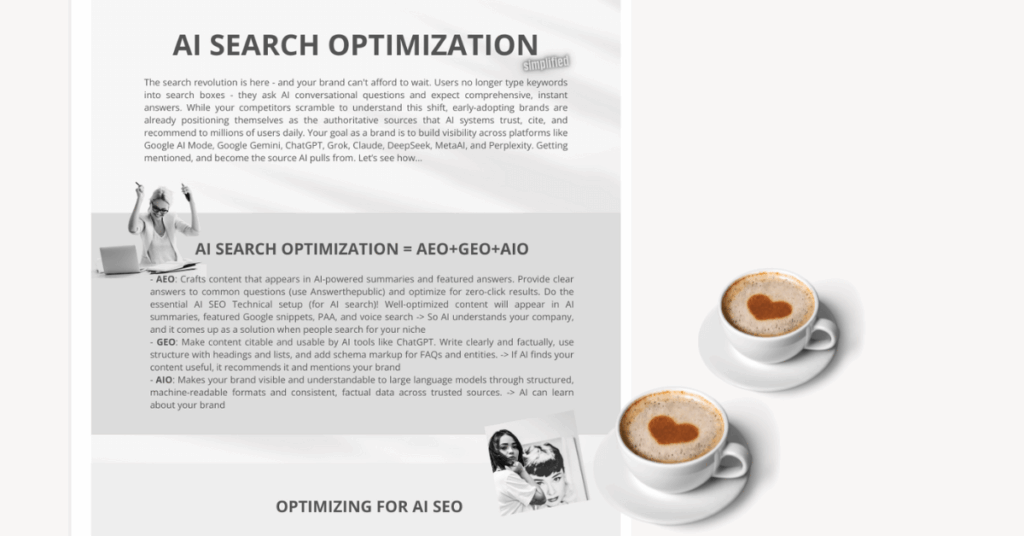
But in the age of AI, the game is different. Traditional SEO is not enough anymore. Users no longer type keywords into search boxes – they ask AI conversational questions and expect comprehensive, instant answers. Be an early adopter!
While your competitors scramble to understand this shift, early adopting brands are already positioning themselves as the authoritative sources that AI systems trust, cite, and recommend to millions of users daily.
YOUR GOAL AS A BRAND is to BUILD VISIBILITY across platforms like Google AI Mode, Google Gemini, ChatGPT, Grok, Claude, DeepSeek, and Perplexity. Getting mentioned and BECOMING THE SOURCE AI PULLS FROM.
The search revolution is here – and your brand can’t afford to wait. Get the essential AI Search Optimization Cheat Sheet, and start optimizing your content for AI search across Google AI Mode, ChatGPT, Perplexity, and more.
brand architecture guide brand attributes brand experience brand message house brand mistakes to avoid brand personality brand value business brand business brand building copywriting copywriting frameworks employer brand employer branding marketing psychology tagline